Francis Petrarch
The Ascent of Mount Ventoux
Letter to his confessor, Dionisio da Borgo San Sepolcro, translated (from
Latin)
James Harvey Robinson, ed. and trans.
Petrarch: The
First Modern Scholar and Man of Letters
(New York: G.P. Putnam, 1898)
To-day I made the ascent of the highest mountain in this region, which is not improperly called Ventosum. [‘Ventosum’, windy] My only motive was the wish to see what so great an elevation had to offer. I have had the expedition in mind for many years; for, as you know, I have lived in this region from infancy, having been cast here by that fate which determines the affairs of men. Consequently the mountain, which is visible from a great distance, was ever before my eyes, and I conceived the plan of some time doing what I have at last accomplished to-day. The idea took hold upon me with especial force when, in re-reading Livy's History of Rome, yesterday, I happened upon the place where Philip of Macedon, the same who waged war against the Romans, ascended Mount Haemus in Thessaly, from whose summit he was able, it is said, to see two seas, the Adriatic and the Euxine – it seems to me that a young man in private life may well be excused for attempting what an aged king could undertake without arousing criticism.
When I came to look about for a companion I found, strangely enough, that hardly one among my friends seemed suitable, so rarely do we meet with just the right combination of personal tastes and characteristics, even among those who are dearest to us.... I rejected those who were likely to irritate me by a cold want of interest, as well as those who might weary me by their excessive enthusiasm. Such defects, however grave, could be borne with at home, for charity suffereth all things, and friendship accepts any burden; but it is quite otherwise on a journey, where every weakness becomes much more serious. And - would you believe it? - I finally turned homeward for aid, and proposed the ascent to my only brother, who is younger than I. He was delighted and gratified beyond measure by the thought of holding the place of a friend as well as of a brother.
At the time fixed we left the house, and by evening reached Malaucene, which lies at the foot of the mountain, to the north. Having rested there a day, we finally made the ascent this morning, with no companions except two servants; and a most difficult task it was. The mountain is a very steep and almost inaccessible mass of stony soil. But, as the poet has well said, “Remorseless toil conquers all.” It was a long day, the air fine. We enjoyed the advantages of vigour of mind and strength and agility of body, and everything else essential to those engaged in such an undertaking and so had no other difficulties to face than those of the region itself. We found an old shepherd in one of the mountain dales, who tried, at great length, to dissuade us from the ascent, saying that some fifty years before he had, in the same ardour of youth, reached the summit, but had gotten for his pains nothing except fatigue and regret, and clothes and body torn by the rocks and briars. No one, so far as he or his companions knew, had ever tried the ascent before or after him. But his counsels increased rather than diminished our desire to proceed, since youth is suspicious of warnings. So the old man, finding that his efforts were in vain, went a little way with us, and pointed out a rough path among the rocks, uttering many admonitions, which he continued to send after us even after we had left him behind. Surrendering to him all such garments or other possessions as might prove burdensome to us, we made ready for the ascent, and started off at a good pace. But, as usually happens, fatigue quickly followed upon our excessive exertion, and we soon came to a halt at the top of a certain cliff. Upon starting on again we went more slowly, and I especially advanced along the rocky way with a more deliberate step. While my brother chose a direct path straight up the ridge, I weakly took an easier one which really descended. When I was called back, and the right road was shown me, I replied that I hoped to find a better way round on the other side, and that I did not mind going farther if the path were only less steep. This was just an excuse for my laziness; and when the others had already reached a considerable height I was still wandering in the valleys. I had failed to find an easier path, and had only increased the distance and difficulty of the ascent. At last I became disgusted with the intricate way I had chosen, and resolved to ascend without more ado. When I reached my brother, who, while waiting for me, had had ample opportunity for rest, I was tired and irritated. We walked along together for a time, but hardly had we passed the first spur when I forgot about the circuitous route which I had just tried, and took a lower one again. Once more I followed an easy, roundabout path through winding valleys, only to find myself soon in my old difficulty. I was simply trying to avoid the exertion of the ascent; but no human ingenuity can alter the nature of things, or cause anything to reach a height by going down. Suffice it to say that, much to my vexation and my brother's amusement, I made this same mistake three times or more during a few hours.
After being frequently misled in this way, I finally sat down in a valley and transferred my winged thoughts from things corporeal to the immaterial, addressing myself as follows: – “What thou hast repeatedly experienced to-day in the ascent of this mountain, happens to thee, as to many, in the journey toward the blessed life. But this is not so readily perceived by men, since the motions of the body are obvious and external while those of the soul are invisible and hidden. Yes, the life which we call blessed is to be sought for on a high eminence, and strait is the way that leads to it. Many, also, are the hills that lie between, and we must ascend, by a glorious stairway, from strength to strength. At the top is at once the end of our struggles and the goal for which we are bound. All wish to reach this goal, but, as Ovid says, ‘To wish is little; we must long with the utmost eagerness to gain our end.’ Thou certainly dost ardently desire, as well as simply wish, unless thou deceivest thyself in this matter, as in so many others. What, then, doth hold thee back? Nothing, assuredly, except that thou wouldst take a path which seems, at first thought, more easy, leading through low and worldly pleasures. But nevertheless in the end, after long wanderings, thou must perforce either climb the steeper path, under the burden of tasks foolishly deferred, to its blessed culmination, or lie down in the valley of thy sins, and (I shudder to think of it!), if the shadow of death overtake thee, spend an eternal night amid constant torments.”
These thoughts stimulated both body and mind in a wonderful degree for facing the difficulties which yet remained. Oh, that I might traverse in spirit that other road for which I long day and night, even as to-day I overcame material obstacles by my bodily exertions! And I know not why it should not be far easier, since the swift immortal soul can reach its goal in the twinkling of an eye, without passing through space, while my progress to-day was necessarily show, dependent as I was upon a failing body weighed down by heavy members.
One peak of the mountain, the highest of all, the country people call “Sonny,” why, I do not know, unless by antiphrasis, as I have sometimes suspected in other instances; for the peak in question would seem to be the father of all the surrounding ones. On its top is a little level place, and here we could at last rest our tired bodies.
At first, owing to the unaccustomed quality of the air and the effect of the great sweep of view spread out before me, I stood like one dazed. I beheld the clouds under our feet, and what I had read of Athos and Olympus seemed less incredible as I myself witnessed the same things from a mountain of less fame. I turned my eyes toward Italy, whither my heart most inclined. The Alps, rugged and snow-capped, seemed to rise close by, although they were really at a great distance; the very same Alps through which that fierce enemy of the Roman name once made his way, bursting the rocks, if we may believe the report, by the application of vinegar.
[Here for several paragraphs he contemplates his life so far, his love of Laura, and his spiritual failings.] I had well-nigh forgotten where I was and our object in coming; but at last I dismissed my anxieties, which were better suited to other surroundings, and resolved to look about me and see what we had come to see. The sinking sun and the lengthening shadows of the mountain were already warning us that the time was near at hand when we must go. As if suddenly wakened from sleep, I turned about and gazed toward the west. I was unable to discern the summits of the Pyrenees, which form the barrier between France and Spain; not because of any intervening obstacle that I know of but owing simply to the insufficiency of our mortal vision. But I could see with the utmost clearness, off to the right, the mountains of the region about Lyons, and to the left the bay of Marseilles and the waters that lash the shores of Aigues Mortes, altho' all these places were so distant that it would require a journey of several days to reach them. Under our very eyes flowed the Rhone.
While I was thus dividing my thoughts, now turning my attention to some terrestrial object that lay before me, now raising my soul, as I had done my body, to higher planes, it occurred to me to look into my copy of St. Augustine's Confessions. I opened the compact little volume, small indeed in size, but of infinite charm, with the intention of reading whatever came to hand, for I could happen upon nothing that would be otherwise than edifying and devout. Now it chanced that the tenth book presented itself. My brother, waiting to hear something of St. Augustine&apos's from my lips, stood attentively by. I call him, and God too, to witness that where I first fixed my eyes it was written: “And men go about to wonder at the heights of the mountains, and the mighty waves of the sea, and the wide sweep of rivers, and the circuit of the ocean, and the revolution of the stars, but themselves they consider not.” I was abashed, and, asking my brother (who was anxious to hear more), not to annoy me, I closed the book, angry with myself that I should still be admiring earthly things who might long ago have learned from even the pagan philosophers that nothing is wonderful but the soul, which, when great itself, finds nothing great outside itself. Then, in truth, I was satisfied that I had seen enough of the mountain; I turned my inward eye upon myself, and from that time not a syllable fell from my lips until we reached the bottom again.
How many times, think you, did I turn back that day, to glance at the summit of the mountain which seemed scarcely a cubit high compared with the range of human contemplation, – when it is not immersed in the foul mire of earth? With every downward step I asked myself this: If we are ready to endure so much sweat and labour in order that we may bring our bodies a little nearer heaven, how can a soul struggling toward God, up the steeps of human pride and human destiny, fear any cross or prison or sting of fortune? How few, I thought, but are diverted from their path by the fear of difficulties or the love of ease! How happy the lot of those few, if any such there be! It is of them, assuredly, that the poet was thinking, when he wrote:
Happy the man who is skilled to
understand
Nature's hid causes; who beneath his feet
All terrors casts, and death's relentless doom,
And the loud roar of greedy Acheron.
How earnestly should we strive, not to stand on mountain-tops, but to trample beneath us those appetites which spring from earthly impulses.
With no consciousness of the difficulties of the way, amidst these preoccupations which I have so frankly revealed, we came, long after dark, but with the full moon lending us its friendly light, to the little inn which we had left that morning before dawn.
Malaucene, April 26 [1336]
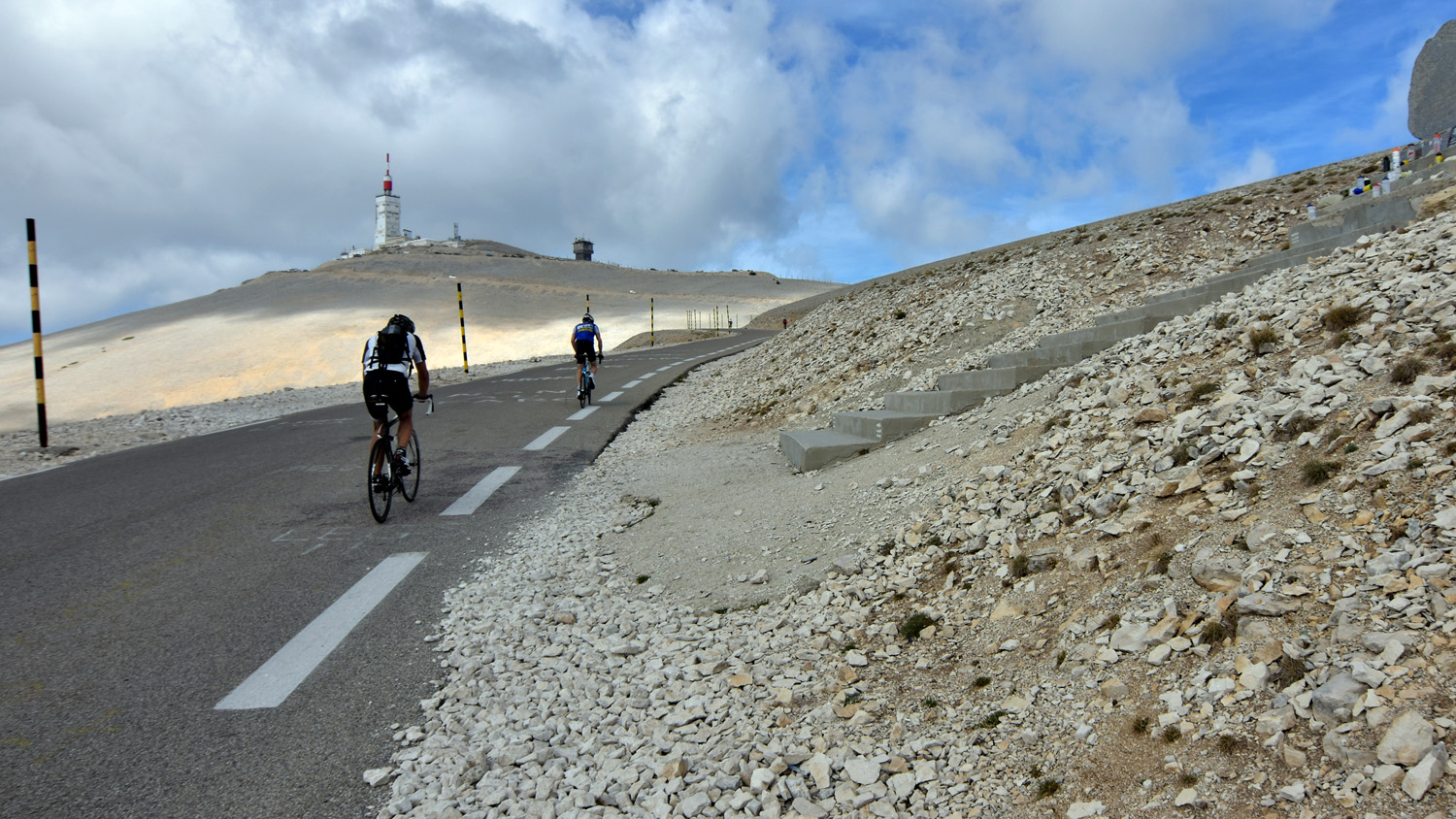
Cyclists approach the summit of Mont Ventoux